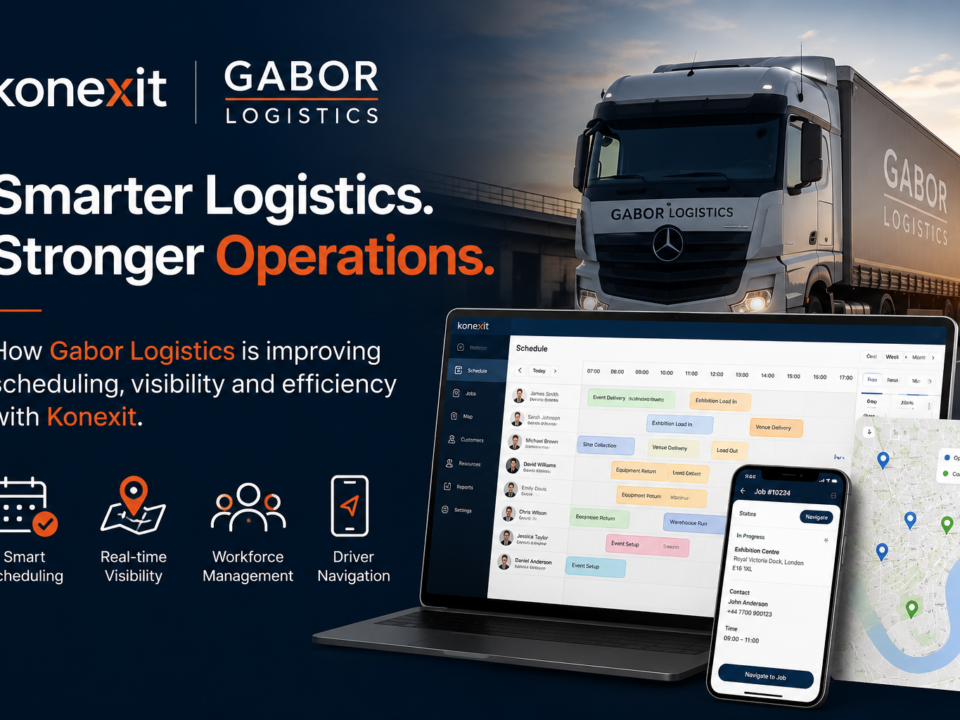
Gabor Logistics Connects Its Entire Operation with Konexit
August 13, 2026New Digital Waste Tracking requirements are changing the way waste businesses record and report information about the waste they receive and move.
For skip hire companies, waste transfer stations and other waste operators, this means preparing for a move towards more structured digital records.
So what does this mean in practice, and where could digital data capture help?
Talk to us about Digital Waste TrackingInformation that can be captured digitally
- Waste type and description
- EWC / List of Waste code
- Quantity or weight
- Collection and receipt details
- Carrier and vehicle information
- Photographic evidence
- Customer or driver signatures
- Automatic timestamps
- GPS coordinates
- Barcode or QR code scans
What is changing?
The UK is introducing Digital Waste Tracking to improve the information recorded about waste as it moves through the waste management system.
The changes are being introduced in phases. For many skip hire businesses, the important question is whether they simply collect and transport waste or whether they also operate the permitted waste site where skips are returned, tipped and sorted.
When does Digital Waste Tracking apply?
The new requirements are being introduced in stages, so different parts of a skip hire operation may be affected at different times.
Permitted waste receiving sites
In England and Wales, permitted and licensed waste receiving sites are required to digitally report information about controlled waste they receive.
This can include skip hire businesses that bring collected skips back to their own permitted waste transfer or sorting facility.
Waste collectors and carriers
Digital Waste Tracking is planned to expand further to include waste collectors such as carriers, brokers and dealers.
This is particularly relevant to skip hire businesses when collecting and transporting waste from customer locations.
Businesses should check current government guidance to confirm which requirements and implementation dates apply to their individual operation.
What could this mean for a typical skip hire company?
Consider a skip hire company with 100 skips operating across its local area.
A customer phones and orders a skip. The company delivers the empty skip to the customer's property and the customer fills it over the following two weeks.
The skip hire company then returns, collects the full skip and transports it back to its own permitted waste yard, where the contents are sorted into different waste categories.
For businesses completing large numbers of collections every day, this creates an obvious challenge: how do you capture accurate, structured information without creating significant additional administration?
Capture the information where the work happens
One approach is to give drivers and yard operatives a digital form that can be completed directly from a mobile phone or tablet.
Rather than relying on handwritten paperwork that needs to be interpreted and entered into another system later, information can be captured electronically at source.
See what the app might look like
A simple mobile form can guide drivers and yard operatives through the information they need to capture, with important fields presented in an easy-to-follow format.
View example mobile appView an example of how a KoneXit mobile data capture form could be configured for a waste or skip hire operation. The exact fields can be configured around the requirements of the individual business.
Identify the skip
Scan a barcode or QR code attached to the skip, or select the relevant job on the mobile device.
Capture the waste
Record the waste description, classification code, quantity, weight and other relevant information.
Add supporting evidence
Take photographs, capture signatures and automatically record the date, time and GPS location where appropriate.
Create the digital record
Submit the completed information electronically so it can be reviewed, searched, processed or integrated with other business systems.
What information could be captured?
Digital forms can be configured around the individual waste operator and the information its staff need to collect.
Photograph the contents of the skip, contamination, condition of the load or supporting documentation.
Automatically capture the location associated with a collection, delivery or other activity.
Automatically timestamp completed forms and stages within a workflow.
Identify skips, containers, jobs or other assets without manually entering reference numbers.
Capture customer, driver or authorised-person signatures directly on the mobile device.
Use dropdown lists, mandatory questions, numeric fields and validation rules to improve consistency.
Example: recording a skip returning to the yard
When a driver collects a full skip and returns it to the company's permitted waste facility, a digital workflow could capture information about the movement, the waste and any supporting evidence required by the business.
Movement
Job number Skip or container ID Collection address Date and time Vehicle registration Carrier details
Waste
Waste description EWC / List of Waste code Quantity or weight Recovery/disposal information Hazard information where applicable
Supporting information
Photos of the load GPS position Driver confirmation Customer signature Yard receipt confirmation
More than simply replacing a paper form
Moving data capture onto a mobile device can provide benefits beyond preparing for Digital Waste Tracking.
Information can be captured once, at source, and made immediately available to office staff rather than waiting for paperwork to return with the driver.
Mandatory fields and validation can help prevent incomplete records. Dropdown lists can help standardise information, while barcode scanning can reduce errors caused by manually entering skip or job numbers.
Photographs, timestamps and location information can also provide useful supporting evidence for the wider business operation.
How KoneXit can help
KoneXit can provide waste and skip hire businesses with configurable mobile forms designed around their own operational processes.
Forms can be used on mobile devices by drivers, yard operatives and other members of staff to capture structured information digitally at the point the work takes place.
Depending on the workflow, this can include text and numeric information, photographs, barcode and QR code scanning, GPS coordinates, automatic timestamps and digital signatures.
The objective is simple: capture accurate information once, electronically and at source, rather than creating additional paperwork and administration.
Preparing your waste business for Digital Waste Tracking?
If you're looking at how your drivers or yard staff could capture waste information digitally, talk to us about building a workflow around the way your business already operates.
Talk to KoneXitEmail: support@konexit.co.uk
This article is intended to provide general information about Digital Waste Tracking and digital data capture. It does not constitute legal, regulatory or compliance advice.
Businesses remain responsible for determining the requirements that apply to their individual operations and for submitting required information to the appropriate government waste tracking service.